Call for Book Chapters: The Contemporary Bangsamoro

Call for Book Chapters

The Contemporary Bangsamoro

Editors

A book project collaborated by the Mindanao State University’s Institute of Peace and Development in Mindanao (MSU Marawi’s IPDM), Bangsamoro Research Network (BRLN), University of the Philippines Bangsamoro Studies Group (UP BSG), and the Heavenly Culture, World Peace, Restoration of Light (HWPL).

The project collaborators open the submission of book chapter proposals for the upcoming anthology “The Contemporary Bangsamoro,” a compendium of both academic and policy papers that engage the different aspects and angles of the Bangsamoro and the changing character of its society and politics, religio-cultural practices, history, economy, security, and environment. As a rapidly evolving autonomous region as well as a fluid sociopolitical identity, this monograph aims to shed light on historical issues alongside its current status, concerns, and future prospects. It offers a comprehensive, interdisciplinary examination of the Bangsamoro as it continues to navigate post-conflict governance, economic development, political transformations, and social change. The Contemporary Bangsamoro moves beyond a generalized view of the autonomous region by emphasizing provincial heterogeneity—how different provinces within the region experience governance, economic development, security, and social dynamics differently. It also includes perspectives and views of Moro societies outside the region both in the country and overseas. By integrating case studies from Maguindanao del Norte, Maguindanao del Sur, Lanao del Sur, Basilan, Sulu, Tawi-Tawi, Special Geographic Area (SGA) in North Cotabato, and Moro communities outside the region, the book provides a granular understanding of how local, national, and international variations affect policy implementation and development outcomes.

Prolegomenon

The use of the term “bangsa” alongside “Moro” is more than a hundred years old, with a newspaper in 1911 mentioning it as a counterpoint to “bangsa tau puti” or people of European descent, referring to those at the apex of colonial power. In 1924, we see its English translation “Moro Nation” resurface in the Zamboanga Declaration whereby prominent Moro leaders of the time expressed their protestations in being included in an independent Filipino nation. Here, it morphed as a counterpoint to the Filipino, and 11 years later, the Dansalan Declaration of 1935 further amplified the need for a distinct nation for the Moro people, binding the 13 Muslim ethnolinguistic groups of Mindanao, Sulu, and Palawan in a single political possibility. History did not favor this independence campaign, however, and more than three decades later, the Jabidah Massacre of 1968 prompted one of the biggest internal crises of the Philippines as it commenced the Bangsamoro struggle that continues to persist today in changing configurations.

With this brief overview, a far cry from the complex reality of its chronological journey, the delineation of the Bangsamoro identity grew in scope and meaning, now embracing both settlers and non-Moro indigenous peoples as a voluntary self-identification. The dynamism of the Bangsamoro as demonstrated by its historical antecedents, hence, demands a constant renewal of analysis. In this anthology, the project collaborators aim to breathe life into our current conceptual categories and empirical resources in understanding the Bangsamoro and its sociopolitical, historical, economic, religio-cultural, environmental and security aspects. With this overarching direction, it further aims to provide clarity as to its contemporary character, concerns, and potential trajectories as well as steer clear from ambiguities and misconceptions persistent in academic, official, and practical discussions and debates on the Bangsamoro.

Objectives

With the monograph’s emphasis on the contemporary condition of the Bangsamoro, its society and politics, history, culture, economy, religious practice, environment, and security, the book aims to achieve the following:

  • To introduce up-to-date conceptual and empirical insights and findings of the Bangsamoro as both an autonomous region and an identity beyond geographical limitation;
  • To provide clarity to the current understanding of the Bangsamoro and dispel recurring misconceptions given its dynamic and multifaceted characteristics;
  • To explore and discuss potential futures that address present concerns, ranging from issues of inclusivity and governance to transition and justice, among many others;
  • To serve as a key reference for understanding BARMM’s governance, economy, and social landscape at a provincial level; and,
  • To inform discussions on policy, peacebuilding, and development while offering a research-driven perspective.

Themes

Bringing together leading Bangsamoro scholars, policymakers, and practitioners, this book addresses the following key themes:

Part I: Political Transformations and Governance: Examines governance challenges, the persistence of political dynasties, and institutional reforms across different provinces.

Part II: Economic Development and Informal Sectors: Analyzes economic diversification, informal economies, and the role of private sector growth across the Bangsamoro.

Part III: Peace, Security, and Justice: Investigates security threats, transitional justice, and law enforcement mechanisms in the provinces.

Part IV: Social Change, Identity, and Education: Explores socio-cultural diversity, educational reforms, and the role of women and youth in the provinces.

Part V: Provincial Perspectives and Comparative Analyses: Highlights the political, economic, and social heterogeneity of BARMM’s provinces, focusing on disparities, opportunities, and local governance models.

Part VI: Sustainability and Development Challenges: Addresses climate resilience, infrastructure gaps, and development planning within the region.

Contents

Introduction: The introductory chapter provides an overview of BARMM’s transition, the significance of examining its provinces individually, and the book’s interdisciplinary approach.

Part I: Political Transformations and Governance

01. The Bangsamoro Transition: Progress, Governance Gaps, and Provincial Disparities

  • Evaluates the performance of the Bangsamoro Transition Authority (BTA) across different provinces and municipalities.

02. Political Dynasties in BARMM: Continuities and Divergences Across Provinces

  • Analyzes how political families dominate governance in different provinces and their impact on policymaking.

03. Decentralization and Local Governance: The Role of Provincial Governments

  • Compares governance structures across BARMM’s provinces, exploring fiscal autonomy and service delivery.

Part II: Economic Development and Informal Sectors

04. Economic Growth in BARMM: Provincial Disparities and Structural Barriers

  • Examines why some provinces (e.g., Basilan and Tawi-Tawi) have stronger economic performance than others.

05. The Informal Economy in Bangsamoro: Livelihoods and Survival Strategies

  • Investigates the role of informal trading, cross-border economies (Malaysia-Philippines), and local enterprise development.

06. Islamic Banking, Halal Industries, and Investment Zones: Provincial Economic Models

  • Focuses on the development of halal industries in Lanao del Sur and the role of Islamic banking in economic growth.

Part III: Peace, Security, and Justice

07. Security Challenges in BARMM: Understanding Provincial Variations

  • Compares security threats in mainland vs. island provinces, addressing armed groups, crime, and law enforcement.

08. Transitional Justice in the Bangsamoro: Addressing Historical Injustices

  • Discusses how different provinces approach justice for past conflicts and human rights violations.

09. Local Peacebuilding and Traditional Conflict Resolution Mechanisms

  • Highlights how customary laws and religious leaders contribute to peacebuilding in various communities.

10. Role of civil society and international cooperation in promoting peace

  • Tackles the contributions of HWPL and other INGOs and CSOs on international contributions to local peace efforts.

Part IV: Social Change, Identity, and Education

11. Education Reforms in BARMM: Provincial Access and Quality Disparities

  • Examines the varying levels of educational access, including the role of Madaris and public schools.

12. Women and Youth in Bangsamoro’s Political and Economic Landscape

  • Investigates gender roles, youth engagement, and socio-political participation in different provinces.

13. Cultural Diversity in the Bangsamoro: The Intersection of Ethnicity, Religion, and Governance

  • Explores how cultural identity shapes governance and development in various parts of BARMM.

Part V: Provincial Perspectives and Comparative Analyses

14. Maguindanao del Norte and Maguindanao del Sur: The Political and Economic Divide

  • Examines how the split into two provinces has affected governance, service delivery, and economic development.

15. Lanao del Sur: The Maranao Economy and Post-Siege Reconstruction in Marawi

  • Analyzes how Marawi’s rehabilitation influences economic recovery and governance.

16. Basilan: Governance and Economic Resilience in a Conflict-Affected Province

  • Explores Basilan’s post-conflict governance, economic revitalization, and security challenges.

17. Sulu: The Complex Interplay of Traditional Leadership and Governance

  • Discusses how traditional power structures and local politics influence governance in Sulu.

18. Tawi-Tawi: Border Trade, Maritime Economy, and Development Challenges

  • Examines Tawi-Tawi’s strategic role in regional trade and its economic dependence on Malaysia.

Part VI: Sustainability and Development Challenges

19. Climate Change, Disaster Resilience, and Environmental Governance

  • Evaluates environmental risks across the provinces, focusing on adaptation strategies.

20. Infrastructure and Connectivity: Overcoming Development Barriers

  • Analyzes transportation, digital connectivity, and energy access across BARMM’s provinces.

21. Measuring Provincial Progress: Policy Implementation and Development Outcomes

  • Provides a comparative analysis of development indicators across provinces, identifying gaps and policy recommendations.

Contribution to the Field

This book makes a pioneering contribution to the study of governance, development, and conflict resolution in the Bangsamoro by incorporating “we perspective” analyses. It provides:

  • A comparative perspective on governance, security, and economic development across BARMM’s diverse provinces.
  • Policy insights to enhance governance, private sector engagement, and long-term stability in the region.
  • An interdisciplinary approach, combining historical analysis, empirical research, and policy discussions.

Market and Target Audience

This book is intended for:

  • Academic Scholars and Students: Those researching Southeast Asian studies, governance, and conflict resolution.
  • Policymakers and Practitioners: Decision-makers in the Bangsamoro government, national agencies, and international organizations.
  • Civil Society Organizations and Local Leaders: Groups advocating for governance reforms and economic empowerment.
  • General Readers and Regional Observers: Those interested in Bangsamoro’s political and economic landscape.

Contributors (tentative list)

Potential contributors may include scholars and experts from:

  • Mindanao State University (MSU) and IPDM
  • Academic institutions within or outside BARMM
  • Bangsamoro government agencies
  • Development practitioners and policymakers
  • Independent researchers on Bangsamoro governance, economy, and society
  • NGOs and CSOs and various stakeholders

Submit your proposal by filling out the Google form below.

Bridging BARMM: Inform, Inspire, Involve

Bangsamoro Research and Legal Network (BRLN) in cooperation with CBRC will conduct “Bridging BARMM: Inform, Inspire, Involve”

Learn the BARMM’S political landscape, economic opportunities and careers in the Bangsamoro communities, halal marketing and etc.

We invite Muslim Students Associations, Muslim Leaders and Groups, educators and Muslim students to join us in this event.

Forum on Jan 17, from 8AM-12NN at CBRC Headquarters, Sampaloc Manila.

Just click this link to join: https://forms.gle/SwqX9MsbfqfK4CQv7

See you soon, InshaAllah!

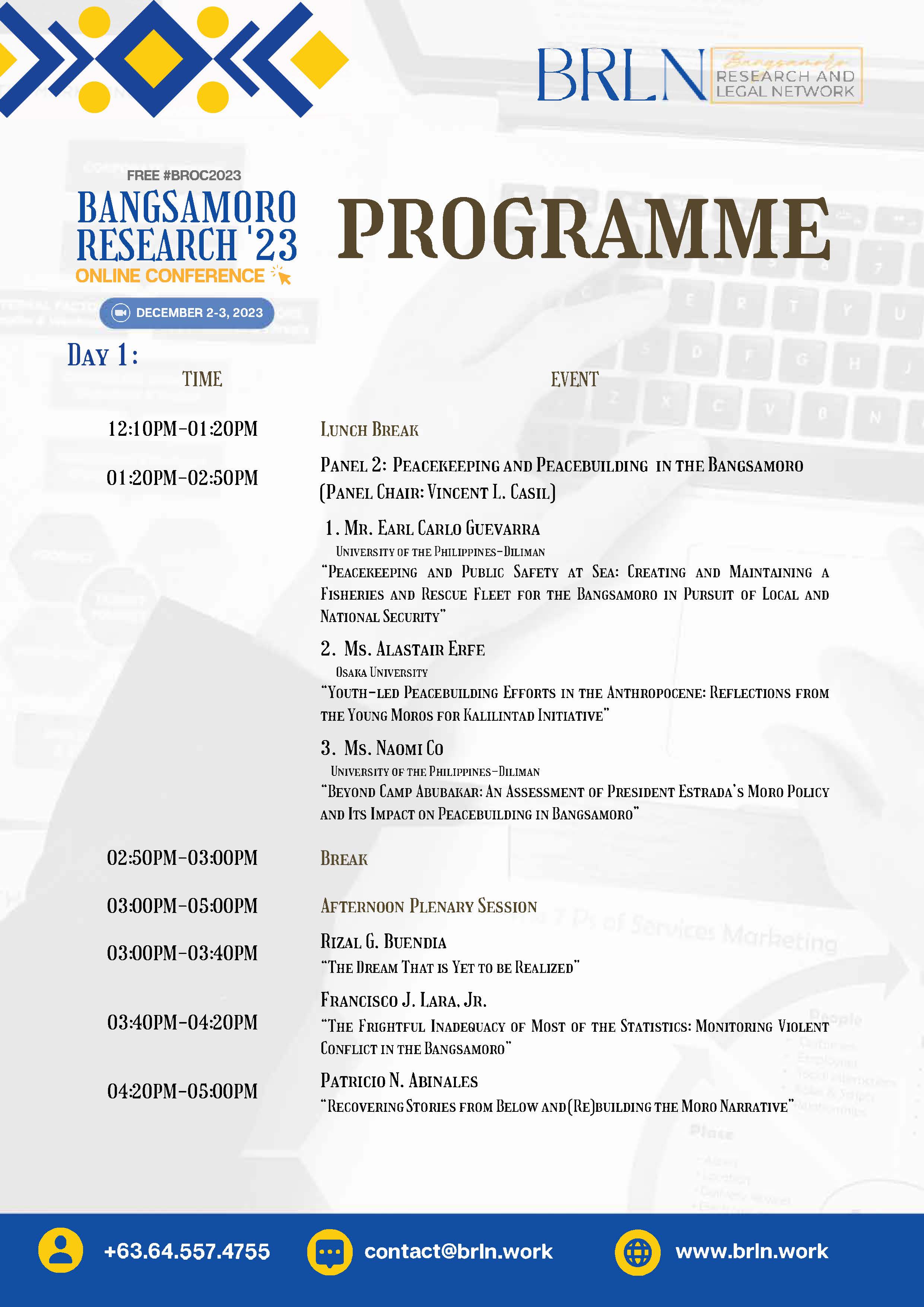
Register and join the free #BROC2023

Join us for this enriching virtual experience on December 2-3, 2023. This conference is a unique opportunity to delve into the diverse facets of the Bangsamoro society, exploring post/decolonial and policy matters through multidisciplinary, interdisciplinary, and transdisciplinary lenses.

Register here for FREE: https://forms.gle/xcqTop4D6D9mLJp97


Download the Conference Programme and Book of Abstract.


Free #BROC2023 (Bangsamoro Research Online Conference 2023)


Join us for this enriching virtual experience on December 2-3, 2023. This conference is a unique opportunity to delve into the diverse facets of the Bangsamoro society, exploring post/decolonial and policy matters through multidisciplinary, interdisciplinary, and transdisciplinary lenses.

Register here for FREE: https://forms.gle/xcqTop4D6D9mLJp97


The Bangsamoro Research Online Conference, a free virtual conference (registration fees are waived) that will be held on 2023 December 2-3, presents and discusses research presentations reflective of multidisciplinary, interdisciplinary, and transdisciplinary studies across post/decolonial and policy matters relevant to philosophical, Islamic, historical, religious, cultural, social, political, economic, environmental, scientific, legal, governmental, and security issues in the Bangsamoro society. To understand the complex dynamics of the region plagued by centuries-long conflicts, underdevelopment, and struggle for self-determination, the conference brings together students, academics, researchers, policymakers, and practitioners aspiring to explore the current state of the Bangsamoro studies and identify key research gaps, challenges, and opportunities. It aims to:

  1. provide a platform for communities, individuals, and stakeholders working on Bangsamoro studies to present their research findings, share experiences, and engage in constructive and meaningful discussions;
  2. identify gaps in existing research and explore network of opportunities for future research collaborations, engagements, and partnerships;
  3. promote multidisciplinarity, interdisciplinarity, and transdisciplinarity approaches to understand science/evidence-based policy issues facing the region; and,
  4. facilitate exchanges of knowledge and best practices among academics, policymakers, and practitioners working to address various Bangsamoro issues.

Keynote speakers (in alphabetical order by their first name):

  • Abhoud Syed M. Lingga is the executive director of the Institute of Bangsamoro Studies in Cotabato City and author of numerous research works including Democratic approach to pursue the Bangsamoro people’ right to self-determination (2002), Assertions of Sovereignty and Self-Determination: The Philippine-Bangsamoro Conflict (2003), Understanding Bangsamoro Independence as a Mode of Self-Determination (2004), Mindanao peace process (2005), Dynamics and management of rido in the Province of Maguindanao (2007), Bangsamoro Self-Determination (2007), The ACEH Peace Process and Lessons for Mindanao (2007), Understanding the Bangsamoro Right to Self-Determination (2008), The Bangsamoro Under the Philippine Rule (2009), Peace is for Everyone: Bangsamoro stories of hope, survival, pain and resilience (2016), Building the Bangsamoro government (2018), among others. Click here to read the abstract of Director Lingga’s presentation.
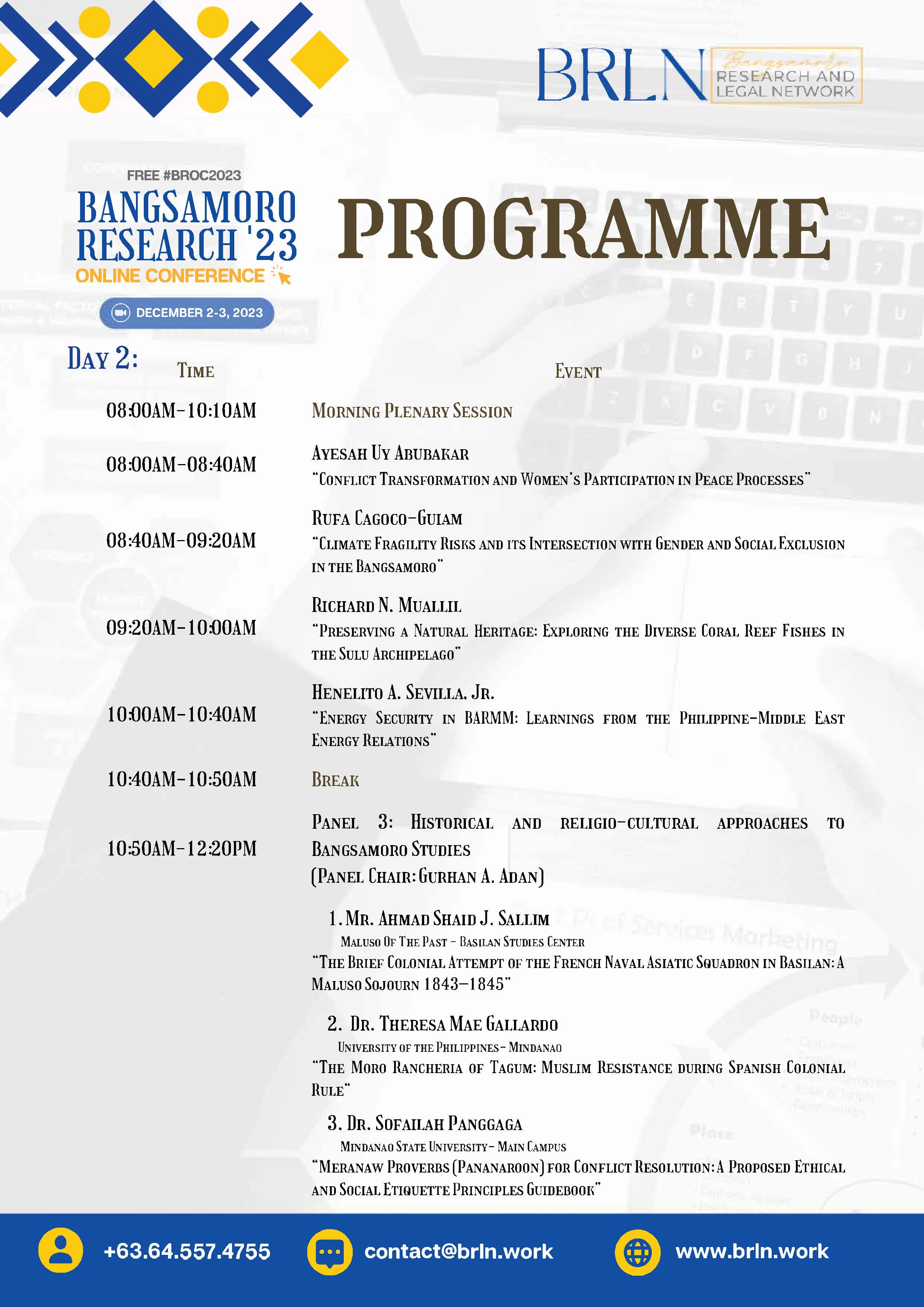
  • Ayesah Uy Abubakar is an Associate Professor at the School of Business and Social Science at Al Bukhary International University, Malaysia, and author of several articles including Keeping the Peace: The International Monitoring Team mission in Mindanao (2005), The Philippines: Challenges to peacebuilding in the GRP-MILF process (2007), Defining the Bangsamoro Right to Self Determination in the MILF Peace Process (2010), The Philippines: Challenges to Peacebuilding in the GRP-MILF Peace Process (2014), Defining the Bangsamoro Right to Self-Determination in the MILF Peace Process (2018), Peacebuilding and Sustainable Human Development: The Pursuit of the Bangsamoro Right to Self Determination (2019), The Study Area: Mindanao and the Bangsamoro Conflict Communities (2019), Mindanao (2019), among others. Click here to read the abstract of Dr. Abubakar’s presentation.
  • Datu Michael O. Mastura is the President and Founder of the Sultan Kudarat Islamic Academy Foundation College, a former Representative (Congressman) of districts of Maguindanao and Cotabato City, served as Deputy Minister of the Office of Muslim Affairs, Board Regent Member of Mindanao State University, Member of the Southern Philippines Development Authority and the Mindanao Economic Council, a former delegate to the 1971 Constitutional Convention, co-founder of the Southeast Asian Shariah Law Association, and author of The Moro Problem: An Approach Through Constitutional Reforms (1971), Aide Memoire on the Question of Autonomy (1975), Administrative Policies Towards the Muslims in the Philippines: A Study in Historical Continuity and Trends (1976), Legal Status of the Sulu Sultanate and the Mindanao Principalities (1982), Shari’a and Social Order in the Philippine Context (1984), Perspectives and Approaches to Muslim Studies in the Philippines: The Umatic Science Imperatives (1985), The Crisis in the MNLF Leadership and the Dilemma of Muslim Autonomy Movement (1985), A Reappraisal of the Administration of Islamic Law in Philippines (1996), Bangsamoro Quest: The Birth of the Moro Islamic Liberation Front (2012), The Rulers of Magindanao in Modern History, 1515–1903: Continuity and Change in a Traditional Realm in the Southern Philippine (2023), among others. Click here to read the abstract of Atty. Mastura’s presentation.
  • Francisco J. Lara Jr. is a retired Professor at the University of the Philippines Diliman, Senior Peace and Conflict Adviser to International Alert Philippines, and author and editor of books and articles including the Agrarian roots of contemporary violent conflict in Mindanao, Southern Philippines (2011), Insurgents, clans and states: Political legitimacy and resurgent conflict in Muslim Mindanao, Philippines (2014), Out of the shadows: Violent conflict and the real economy of Mindanao (2016), Lorries and Ledgers: Describing and Mapping Smuggling in the Field (2021), Conflict’s Long Game: A Decade of Violence in the Bangsamoro (2022), among others. Click here to read the abstract of Prof. Lara’s presentation.
  • Henelito A. Sevilla, Jr. is the Dean and Professor at the Asian Center of the University of the Philippines Diliman, expert on Philippine-Middle East relations, and author of several articles including Why Middle East Matters to the Philippines? (2010), Middle East Security Issues and their Implications to the Philippines (2011), The Republic of the Philippines BID for Observer Status at the OIC: Motivations, Challenges and Opportunities (2013), The Nationalization of Saudi Arabia’s Labor Market and the Filipino Overseas Workers (2016), The Philippines’ Foreign Policy Direction: An Assessment of the First Year of President Duterte (2019), Marginalization of Interests: The Case of Philippine-Middle East Relations (2020), among others. Click here to read the abstract of Dean Sevilla’s presentation.
  • Patricio N. Abinales is a Professor at the Department of Asian Studies, University of Hawaiʻi-Manoa, expert on Mindanao, and author of several books and articles including Making Mindanao: Cotabato and Davao in the Formation of the Philippine Nation-State (2001), Sancho Panza in Buliok Complex: The Paradox of Muslim Separatism (2007), Mindanao, Nation, and Region: The Joys of Dislocation (2008), Orthodoxy and history in the Muslim-Mindanao narrative (2010), Missing the peace in Muslim Mindanao (2015), War and peace in Muslim Mindanao: Critiquing the orthodoxy (2018), Moro Societies in the Philippines before and after the 2017 Marawi Crisis (2018), What sayeth the margins? A note on the state of Mindanao scholarship in Mindanao (2021), among others. Click here to read the abstract of Prof. Abinales’ presentation.
  • Richard N. Muallil is a Professor and Director of Research at the Mindanao State University, Tawi-Tawi College of Technology and Oceanography, and author of several publications including Community assemblages of commercially important coral reef fishes inside and outside marine protected areas in the Philippines (2015), Relative abundance of flying fish gillnet fisheries in Maitum, Sarangani province (2017), Effectiveness of small locally-managed marine protected areas for coral reef fisheries management in the Philippines (2019), Preliminary report on an artisanal fishery for thresher sharks (Alopias spp) in Tawi-Tawi (2020), Inventory of commercially important coral reef fishes in Tawi-Tawi Islands: The Heart of the Coral Triangle (2020), Napoleon wrasse live fishery in the Sibutu islands in Tawi-Tawi, Philippines (2022), among others. Click here to read the abstract of Dr. Muallil’s presentation.
  • Rizal G. Buendia is an Independent Political Analyst, Consultant in Southeast Asian Politics and Governance, former Chair and Associate Professor in Political Science at the De La Salle University, a former Teaching Fellow at the School of Oriental and African Studies, UK, and author of several articles including The GRP-MILF Peace Talks: Quo Vadis? (2004), The secessionist movement and the peace process in the Philippines and Indonesia: The case of Mindanao and Aceh (2005), The state‐Moro armed conflict in the Philippines Unresolved national question or question of governance? (2005), The mindanao conflict in the Philippines: ethno-religious war or economic conflict? (2006), The Politics of Ethnicity and Moro Secessionism in the Philippines (2007), Looking into the future of Moro self-determination in the Philippines (2008), The Ethnopolitics of Moro Self-Determination in the Philippines: So little, too late? (2012), Bangsamoro Secessionism (2018), Charting the Future of the Bangsamoro within the Philippine Nation-State: Governance Challenges, Issues and Recommendations (2019), among others. Click here to read the abstract of Dr. Buendia’s presentation.
  • Rufa Cagoco‐Guiam is a retired Professor from Sociology department of the Mindanao State University in General Santos City, a cultural anthropologist by training, and author of books and articles including Child soldiers in Central and Western Mindanao: a Rapid Assessment (2002), an exploratory study of civil society organizations among Muslim communities in two provinces in the Autonomous Region in Muslim Mindanao (2003), Mindanao Forum: A Series of Discussions on the Mindanao Peace Process (2006), Gender and Livelihoods Among Internally Displaced Persons in Mindanao, Philippines (2012), State of Local Democracy in the Autonomous Region in Muslim Mindanao (2013), Peacebuilding from Below: Conflict resolution, the role of women, and peace governance in select Cotabato, Maguindanao and Sultan Kudarat communities (2015), among others. Click here to read the abstract of Prof. Cagoco-Guiam’s presentation.
  • Sha Elijah B. Dumama-Alba is a Member of the Bangsamoro Transition Authority (BTA), the interim government in the Bangsamoro Autonomous Region in Muslim Mindanao (BARMM) during the transition period and acting as Floor Leader of the Bangsamoro Parliament. As BTA Member of Parliament, she aspires to pass legislations to further the 12-Point Priority Agenda of the Bangsamoro Government. She is currently acting as the Chairperson of the Bangsamoro Parliament’s Committee on Rules and the Vice-Chairperson of the Statutory Committee on Bangsamoro Justice System. Click here to read the abstract of Atty. Dumama-Alba’s presentation.

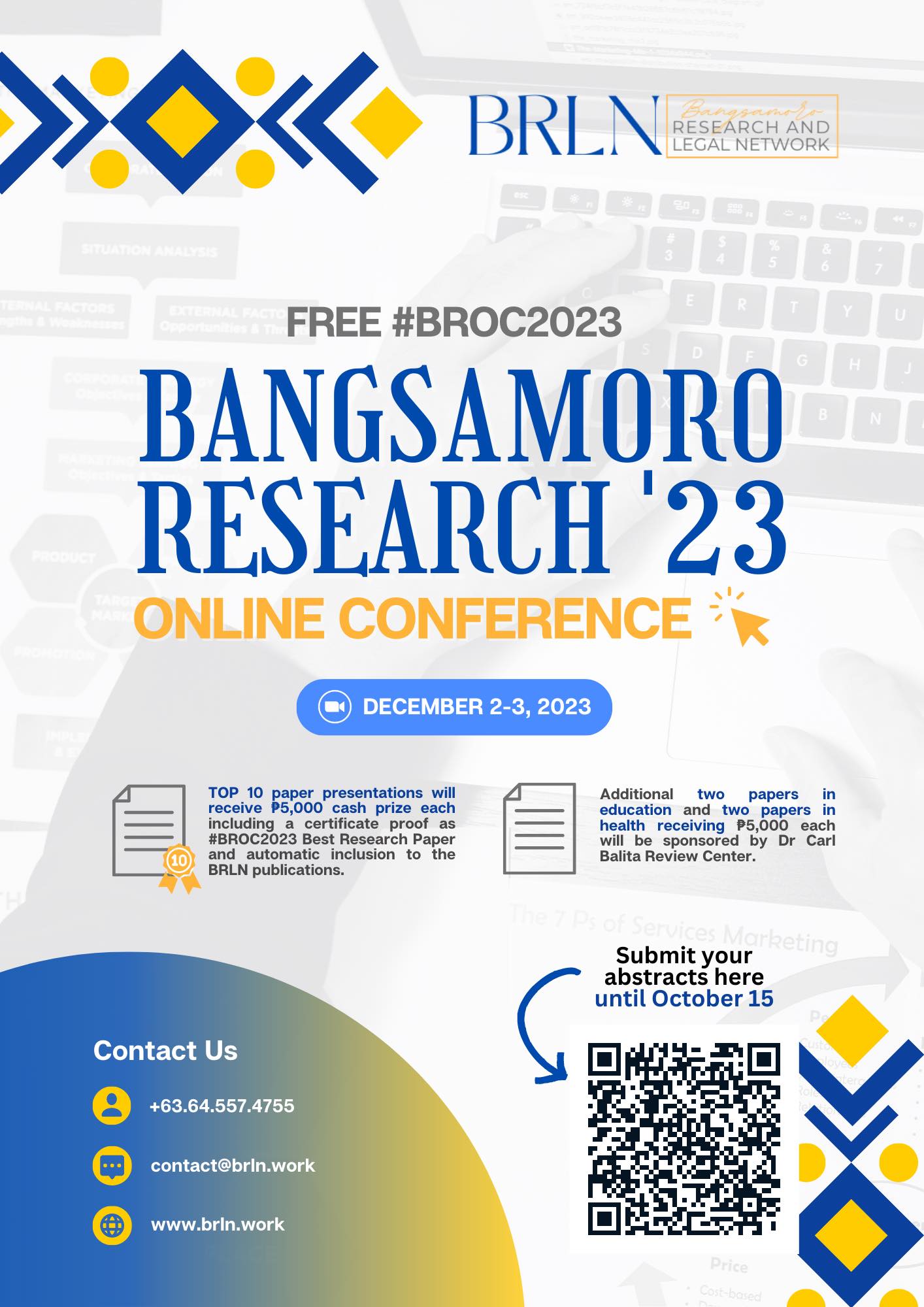
Based on review results of full paper submissions, its top 10 best papers will receive ₱5,000 cash prize each including a certificate proof as #BROC2023 Best Research Paper and automatic inclusion to the BRLN publications. Additional two papers in education and two papers in health receiving ₱5,000 each will be sponsored by Dr Carl Balita Review Center.

The research conference covers a broad range of themes and topics but not limited to:

  1. Dynamics of socio-cultural and ethno-linguistic diversity, norms, folklores, arts, mores (customs), and preservation of cultural heritage, traditional knowledge and practices.
  2. Religious freedom, interfaith and inter-ethnic relations, Islam and the ulamas, and comparative religions and traditional belief systems.
  3. Historical injustices, human rights, and mechanisms for transitional (social) justice, reparation for unjust dispossession, and establishment of the Bangsamoro justice system including shari’ah courts and Islamic law.
  4. Political identity, autonomy, and evolution of the Bangsamoro (moral) governance structures, from (pre)colonial sultanates, 1899 Bates Treaty, 1903 Moro Province, 1913 Department of Mindanao and Sulu, 1920 Bureau of Non-Christian Tribes, 1936 Commissioner for Mindanao and Sulu, 1975 Tripoli Agreement, 1979 Sangguniang Pampook and Lupong Tagapagpaganap ng Pook in Regions IX and XII, 1989 Autonomous Region in Muslim Mindanao (ARMM), to 2019 Bangsamoro Autonomous Region in Muslim Mindanao (BARMM Parliament).
  5. Exploration, development and utilization of untapped economic potential and natural resources such as Liguasan Marsh, including inhabitants’ livelihood, halal economy, trade and investments, tourism, business and commerce management, entrepreneurial opportunities, Islamic banking and finance, and socioeconomic developmental state.
  6. Peacemaking, peacekeeping, peacebuilding, and peace enforcement of public order and safety including rido management, conflict resolution, reconciliation, and reconstruction.
  7. Lifelong learning, Madaris educational system, general secular education, and IPs educational system.
  8. Health science and well-being, traditional and alternative health care system, drug problems, mental rehabilitation, and health policies on (post-)COVID-19 pandemic.
  9. Issues of vulnerable sectors such as Indigenous Peoples, senior citizens (ageism), PWDs, women, youth, children, and settler communities as well as gender issues.
  10. Intergovernmental relations between the National Government and the Bangsamoro Government in the areas of legislation, fiscal policies, maritime cooperation, (renewable) energy, public works and infrastructure (interconnectivity and transportation), sustainable development, and issues with constituent LGUs.
  11. Land and agricultural issues in farming and fisheries including urban land reform, cadastral land surveys, housing and human settlements, and IDPs in Marawi City.
  12. Biodiversity, environmental conservation, disaster risk management, and Anthropocene issues such as food and water shortage, deforestation, extinction of animal and plant species, mining, typhoons, earthquakes, climate change adaptation and global warming.
  13. Labor issues, wage inequality, underemployment, unemployment, and human resource development including migrants and overseas Moro workers.
  14. Preventing and countering violent extremism/radicalism, terrorism, and deradicalization strategies.
  15. Graft and corruption, political dynasties, vote buying, and political patronage.

Abstract submission portal is now open and will close on October 15 while notification of acceptance is on November 06. Please consider submitting your proposed abstract directly to the form below. Thank you.


The conference will feature keynote speeches of scholars working on Bangsamoro studies, as well as paper presentations, panel discussions, and RTDs. Participants will have the opportunity to present their research findings, attend plenary sessions, and engage in discussions with fellow presenters. Participants are expected to present existing knowledge applications, discuss the prospects of generating new knowledge, identify research gaps and challenges, and explore opportunities for future collaborations and partnerships. The conference proceedings will be published as journal articles and/or edited books. Additionally, the conference organizers will explore possibilities for future research engagements.

The free #BROC2023 is a timely initiative that will provide a platform for students, researchers, scholars, and practitioners to come together by sharing experiences and exchanging knowledge, concepts, and ideas on Bangsamoro studies. Such exchanges have the potential to contribute to a deeper understanding of the complex dynamics of the region and inform policies and interventions aimed at promoting sustainable development and furthering peacebuilding efforts.

For inquiries, please email us at contact@brln.work

Datu Michael O. Mastura’s #BROC2023 keynote presentation on “Can Bangsamoro Growth Push Take Political Priority in Muslim Mindanao to the Next Level?”

The norm for politicians in Muslim Mindanao could be more particularly religious for ‘moral governance’ if we leave former liberation front leaders to their own devices. If religion were to intrude into the ‘government-of-the-day politics’ can it be far beyond for their voters in the 2025 election? Given the establishment clause of the country’s constitution that separates religion and politics the all-appointed MPs work in the pretext of cabinet ministries run under color of authority (colorum). That’s why my contribution to the Voices from Moro Land published, in 2007, I already posed the hard question: “Political Islam in the 21st Century Philippines: Can It Survive?” Today, a little more than a decade, those so-called “people of faith” and their religious beliefs are perhaps no more intertwined within an imposed majoritarian composition of the Bangsamoro Transition Authority (BTA) than in public life. At institutional level the lack of accountability drawn from electoral constituencies explains the absence of crucial cabinet collective responsibility to BTA members, even if they are in transition status.

The Muslim faithful and devout supporters are not mutually exclusivists; they include non-elected MPs from MNLF grouping and a few Indigenous peoples.  A project of moralizing the world by MILF-backed brand of proxy politics only suggests: It’s not economics (haram vs halal above all) but growth-points in basic rule of law (al-amr vs an-nahy) debate for the most politically aware. That issue must be taken to a new level of cabinet system as well as parliamentary practice to work out both in the Electoral Code and the Party List System (PLS) with Proportional Representation System (PRS) to function within the framework of democratic competition in politics. In consideration, the right support for growth push with decisions made in the political market—including voter’s exchange value in it—would not generally be accepted legitimacy, moral or legal. And thus what sets up as a rubric for the evaluation of legal as well as economic institutions and norms of human behavior is political education.


As a Muslim public intellectual, lawyer Datu Michael O. Mastura is well acquainted with the attitudes of the Bangsamoro intelligentsia in which Islam becomes a source of identity if not ideology.  His major books are: Muslim Filipino Experience (1984), Bangsamoro Quest (2012), and the latest The Rulers of Magindanao in Modern History (2023). He edited C. A. Majul’s collection of essays entitled Islam and Development (1984). As a lawmaker, congressman Mastura crafted the Code of Muslim Laws in the Philippines (1976); Charter of the Islamic Investment Bank of the Philippines; Philippine Passport Law; and The People’s Television Act. He has been an Amicus Curae to the Supreme Court.  His seminal work on “Legal Pluralism in the Philippines” appeared in the Journal of Law and Society (1994). Also as professional lecturer, he has contributed chapters to books such as Southeast Asians in the Era of Globalization (2014); Islam and Civilizational Renewal; published articles on Islam, Muslim law, and history; other journals devoted to politics, peace negotiation, and contemporary issues. 

Click here to proceed to the conference page.

Patricio N. Abinales’ #BROC2023 keynote presentation on “Recovering Stories from Below and (Re)building the Moro Narrative”

The rehabilitation and restoration of Moro civil society hinges on the recovery of multiple narratives from below, many of which had been suppressed by war. This lecture suggests areas where this is urgently needed, and proposes a collaboration between Moro scholars, public intellectuals and civil society groups with the support from Moro leaders amnd colleagues from “the outside” to pursue this critical endeavor.


Patricio N. Abinales is from Ozamiz City and is currently a professor at the Department of Asian Studies, University of Hawaiʻi-Manoa.

Click here to proceed to the conference page.

Francisco J. Lara Jr.’s #BROC2023 keynote presentation on “The frightful inadequacy of most of the statistics: Monitoring violent conflict in the Bangsamoro”

Conflict data has helped the Bangsamoro peace and subnational state building by filling the critical gap in information that could increase the pressure for an immediate end to hostilities, uncover the true cost of war, and institutionalize a political settlement for peace and stability to endure. However, few have turned to conflict data except for media purposes. The developmental role of conflict data has not been explored as much—why is this the case? The paper addresses the incentives and disincentives in using conflict data by subregional authorities with fragile political authority and the dilemmas faced by development actors who need to account for the peace building impact of their projects and programs. The paper posits a way out of these dilemmas and a better method for determining peacebuilding impact.   


Professor Francisco J. “Pancho” Lara Jr. PhD is a Professor at the University of the Philippines and Senior Peace and Conflict Adviser (Asia) to International Alert UK. He holds an undergraduate degree from the University of the Philippines, and both an MSc (Master of Science) and PhD (Doctor of Philosophy) in International Development from the London School of Economics. He was research associate at the LSE Crisis States Research Centre (2006-2010); taught classes at the LSE Development Studies Institute (2006-2008); and wrote on political economy issues in Indonesia and the Philippines for the LSE-IDEAS Emerging Markets Bulletin from 2007-2009. He authored the book, Insurgents, Clans, and States: Political Legitimacy and Resurgent Conflict in Muslim Mindanao, published by the Ateneo de Manila University Press (2014). He also co-edited and wrote the research methodology chapter of the book on Mindanao’s shadow economies and their links to violent conflict entitled: Out of the Shadows: Violent Conflict and the Real Economy of Mindanao (2016) that won the Philippines National Book Award for the Social Sciences in the same year. In 2021, he co-wrote the chapter on qualitative methodologies in researching smuggling and illicit cross-border trade entitled “Lorries and Ledgers: Describing and Mapping Smuggling in the Field,” in the volume: The Routledge Handbook of Smuggling (2021).

Click here to proceed to the conference page.